
Logo of KWAHO KENYA WATER FOR HEALTH ORGANISATION
HOME ABOUT US NEWS TECHNOLOGY PROJECTS SERVICE CONTACT YOUR ACTION

PROJECTS > BUTERE/MUMIAS


PROJECT DESCRIPTION

Mumias Butere EcoSan promotion project

Project Title

Butere-Mumias district EU-GTZ Ecosan promotion Project –phase 1.

Type of Project

Dissemination of institutional scale urine dehydrating diversion toilet, Biolatrine and rain water harvesting tank.

Project Period December 2007 - January 2008

Start assessment and mobilization: Start 01/12/07, end 31/12/07
Construction and Equipping: Start 1/01/08, end 31/02/08
Fertilizers reuse demo support: Start 31/03/08,

Executing Institution

Kenya Water for Health Organization

Funding Agency

EU/GTZ in collaboration with the Ministries of Health and Water

The Partner Ministries

The Ministry of Water and Irrigation
The Ministry of Health

Location

Mumias divisions in Butere/Mumias districts under Lake Victoria North Water Services Board

The Beneficiaries

2,000 residents of Mumias Butere district, pupils and teachers  of Khaimba  Primary school  – 1000 pupils; - 36 teachers

Ecological Sanitation

Ecological Sanitation is a sanitation approach that can be viewed as a three step process: containment, sanitization and recycling of human excreta. The objective is to protect human health and environment while reducing the use of water and sanitation system and recycling nutrients to help reduce the need for artificial fertilizers in agriculture. Ecosan represents a conceptual shift in the relationship between people and the environment; it is built in the necessary link between people and soil.


Project Design

Aim

To promote development, testing and adaptation of ecological sanitation concept in Butere/Mumias district with focus on:

  1. Protect and conserve natural resources (water, soil and air) from pollution from human and livestock liquid and solid bio-degradable wastes /leftovers.
  2. Sustainably improve the sanitation conditions, increase savings and reduce expenditure for households. For the period of 12 months; 170 households shall be supported with the installation of dehydrating toilets, in Butere/Mumias districts.

The Overall Objective

Increase sanitation coverage using eco-sanitation systems, leading to improved health, increased productivity, poverty reduction and improved management of water resources. Improved skills and consequence adoption and utilization of sustainable sanitation and waste re-use of eco-sanitation systems in communities at Mumias and Matungu, by the end of July 2008.

The Strategy

ecosan
A double vault UDDT ecosan toilet under construction
in Mumias.

To support the Mumias-Matungu communities to implement the eco-sanitation concepts by installation of dehydrating urine separating sanitary facilities, train on the required skills and knowledge on construction, operation, maintenance and reuse of the bio-products. The first installations will be done in 170 selected households, in both Mumias and Matungu in Butere-Mumias district

Expected results / outputs

1. Increased knowledge on construction, maintenance, operation and bio-products utilization of the eco-sanitation systems

  1. 10 ecosan bio-products promoters trained and are promoting the usage
  2. 10 local sanitation artisans trained and are promoting the technology
  3. Eco-sanitation systems accepted in households levels
  4. More households demand for the new technology
  5. The Eco-sanitation by products is effectively utilized by the communities of Butere/Mumias
  6. The eco-sanitation bio- products are effectively utilized by all the 170 households

2. Increased destruction of pathogens through flow stream separation, containment and specific biological treatment

  1. Reduced littered solid and liquid waste
  2. Reduced foul smell from the dump pits, toilets and shower rooms
  3. Elimination of vectors e.g. flies in the toilets and dump-pits

3. Improved resource conservation through reduced use of potable water as a transport medium for human waste and by recovering waste water for irrigations

  1. Bills or expenditure associated with household water supply are reduced by 10%
  2. Reduction in the monthly amount of water used in the households
  3. 100% collection and re-use of waste water from the kitchen, laundry and washrooms

4. Improved resource conservation through reduced deforestation and effective utilization of kitchen and livestock waste matters.

  1. Reduction of incidences of cases related to deforestation or trees felling
  2. 100% collection and re-use of yellow and grey water from the kitchen, and bathrooms in household farming.

Summary of main activities

  1. Facilitate establishment and capacity building of local institutions (C.B.Os, sector collaborators, women groups)
  2. Support 170 households, to install eco-sanitation systems and consequent reuse of facilities and bio-products.
  3. Facilitate collection of baseline and post- projects data on knowledge, attitudes and practices (kaps), technological, socio-economic and environmental in the selected sites.
  4. Facilitate impaction of technical skills and knowledge in construction, operation, maintenance and utilization of Ecosan installation as per following interventions areas:
    • Provision of economically and ecologically sustainable sanitation facilities
    • Safe collection, preservation, sanitization and utilization of organic-fertilizers from the bio-degraded material.
  5. Facilitate impaction of knowledge and skills in value adding chain of bio-degradable waste materials from (human, livestock and markets). Focusing on organization development, management, book-keeping, economic and ecological issues.
  6. Facilitate creation of awareness on the advantages, benefits of ecosan technology in relation to improved environmental health, personal hygiene, general public health and water resource management.

Benefits of ecosan to Mumias Butere community

An essential step in this process of the sanitation is the containment of that which can cause disease. Human faeces contain bacteria, virus and parasites, which if not properly treated can result in spreading diseases such as cholera, typhoid, amoebiasis and worms. Without containment and sanitization, a vicious circle develops where the pathogens in the excreta are released back into the environment, re-infect people through consumption of contaminated water or food, and are then excreted again, only to begin the cycle over.
Eco-sanitation systems are designed around true containment and provide two ways to render human excreta innocuous: dehydration and decomposition. The preferred method will depend on the climate, ground water tables, amount of space and intended purpose for the sanitized excreta.
Dehydration is the chemical process of destroying pathogens by eliminating moisture from the immediate (containing) environment. Some drying materials, like wood ash, lime and soil are added to cover the fresh deposit. Ash and lime increase PH each acts as an additional toxic to factor pathogens if the PH can be raised to over 9.5. The less moisture the better, and in most climates it is better to divert the urine and treat separately.
It takes an average family 6 months to fill one of the vaults. The second vault is used thereafter. The content of the first vault are left to decompose for six months after which is used as farm fertilizer. Urine is diverted into a separate container and later used in diluted form as plant fertilizer. The dry ecotoilet meets all necessary health and environmental criteria and goes all beyond what conventional approach can offer, saving water and preventing water pollution. It produces no smell, does not attract flies and is unaffordable solution inside and outside dwellings through out the world.

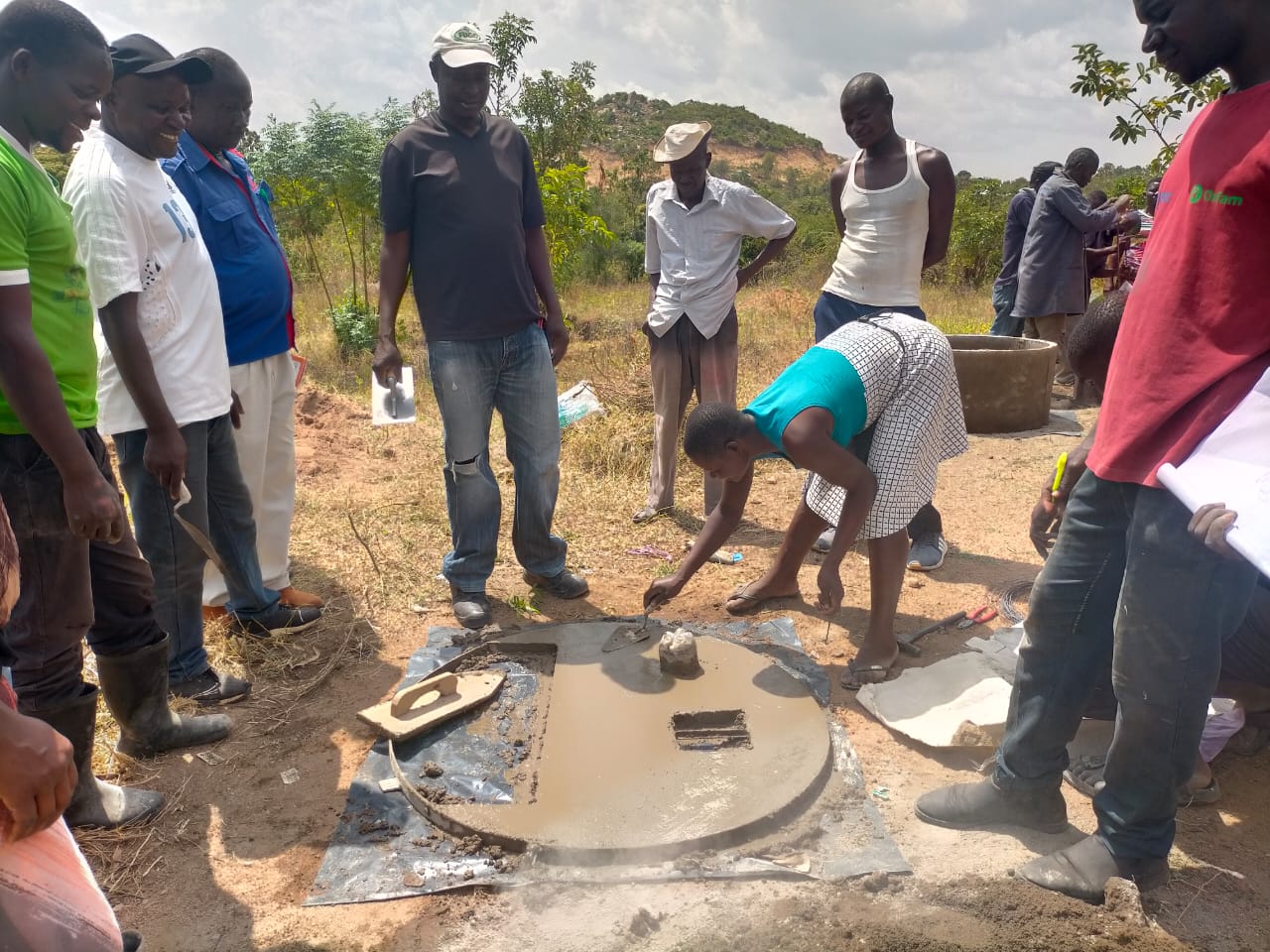
ecosan construction
Artisans working on an ecosan toilet in a school in Mumias.

Recycling

The recycling of nutrients in urine and faeces is one of the key benefits of ecological sanitation. The nitrogen and phosphorous found in urine is a valuable fertilizer and the organic contents of faeces makes the compost product-humus- an excellent soil conditioner. It is important to recover and re-use this nutrient towards sustainable ecosystem to reduce the drain on natural reserves and lessen the dependence on artificial chemical fertilizers.

Socio-economic Impact

Ecological sanitation can improve social and economic conditions for all, but especially for impoverished communities. Ecosan offers empowerment and safety, particularly to women and girls in rural, peri-urban and urban areas that are often without sanitation, by providing private and dignified environment for urination and defecating. The use of sanitized human excreta as a fertilizer stimulates crop growth and, as a result, increases nutrition for those who depend on subsistence farming, or helps to generate or supplement income for those who sell the products they grow.

Ecosan for Grey Water treatment and composting of Household Organics

The ecological sanitation approach will be broadened to cover all organic material generated in households (kitchen and food wastes). When these organic materials are sorted within the home, rather than mixed with solid waste and dumped, they become valuable recyclable materials once composted. Grey water will be treated using biological systems such as evapotranspiration beds and constructed wetlands.


TOP | HOME | INTRODUCTION | NEWS | TECHNOLOGY | PROJECTS | SERVICE | CONTACT | YOUR ACTION
Bookmark this page

© KWAHO, ,