


TECHNOLOGY > RAIN WATER HARVESTING
Rain Water Harvesting
Introduction
Rain water harvesting (RWH) systems can, to some extent, help improve
water provision where required and encourage water conservation, thereby
reducing the demand on existing water sources.
Another benefit of RWH systems is that the surface runoff during storms,
which causes floods and erosion, is reduced, since the rainwater is retained
in the storage tanks. Additionally, the delayed release leads to accumulation
of ground water.
The technology of RWH can be as complex or as simple as required. Many
groups and individuals throughout the world have taken the initiative
and developed a wide variety of different solutions. Due to the flexibility
and adaptability to a very wide range of conditions, these systems are
now being used in the wettest and driest regions and in the richest and
poorest societies of the world.
The industrialised world has developed sophisticated RWH systems with
the aim of reducing water bills or to meet the needs of remote communities
or individual households in arid regions. These countries have recognised
RWH as a solution to the problems of overexploitation of water resources
and are working on user friendly, reliable and high quality systems in
a cost-effective manner.
RWH is also able to address the developing world’s need for an inexpensive
and suitable water supply technology, but the adapting and spreading happens
more slowly than in the industrialised world.
Technique
A rainwater harvesting system contains three basic sub-systems: a collection area, usually as a roof, a guttering system to convey the water and a storage system. Additional peripheral equipment is or can be included, like a water gauge, filters and first flush devices.
Figure 1: Typical Domestic Roofwater Harvesting System in Kenya
- Catchment area: Most roofs are covered with impervious materials
such as corrugated galvanised iron (GI) sheets. The size of the catchment
area determines the quantity of the collected rainwater. There is also
a close connection to the quality of the water, since the major contamination
of rainwater occurs after contact with the catchment surface.
- Conveyance: The guttering system is used to convey the precipitation
from the roof to the storage tank. Gutters are often the weak link in
the rainwater harvesting system, which not only causes functional failure
and less yield, but can also become a health hazard. Since poor installations
allow water, leaves and other debris to enter and remain in the gutters,
good workmanship and proper maintenance are crucial. This helps to safeguard
the water quality and reduces the risk of creating mosquito-breeding places.
The cost of the gutters and down-pipes mount up to 5-15% of the total
system cost.
- Storage tanks: Storage is necessary, since rain does not always
fall when it is required. The water demand and the amount of precipitation
determine the required storage capacity for a given reliability. Since
the tank is generally the most expensive part of the system, special attention
has to be turned on its design and construction. However, rationing schedules
and management strategies are essential to save capacity volume and cost
of the system.

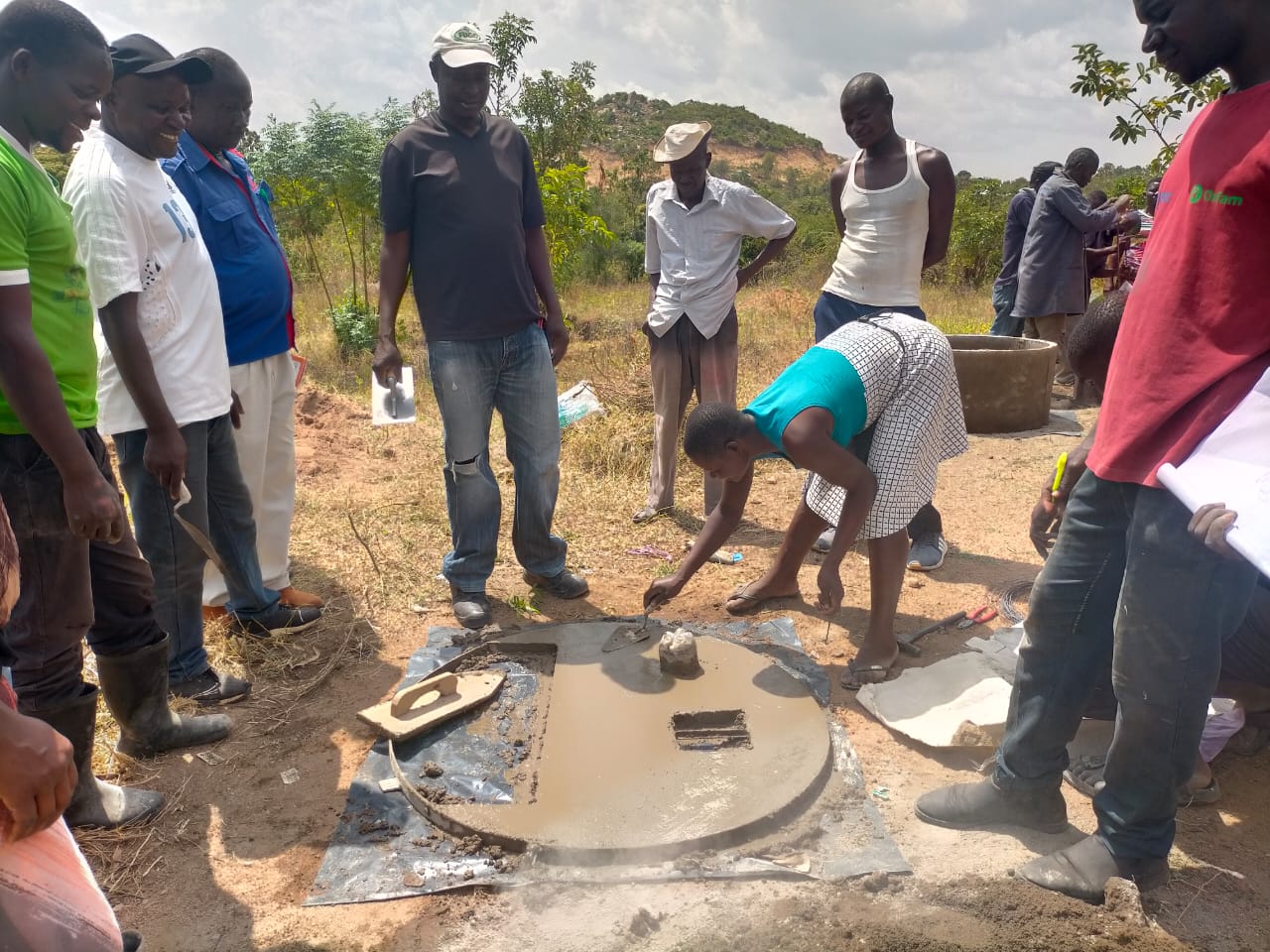
Construction of a ferro cement water tank.

A complete RWH system where the CGI roof was build especially for rain
water harvesting
Downloads
-
Thesis
about Rainwater Harwesting in Maseno by Andreas Krenn (.pdf,
12MB)
Description of project areas where RWH is implemented:
TOP | HOME | INTRODUCTION | NEWS | TECHNOLOGY | PROJECTS | SERVICE | CONTACT | YOUR ACTION
Bookmark this page
© KWAHO, ,
KENYA WATER FOR HEALTH ORGANISATION